

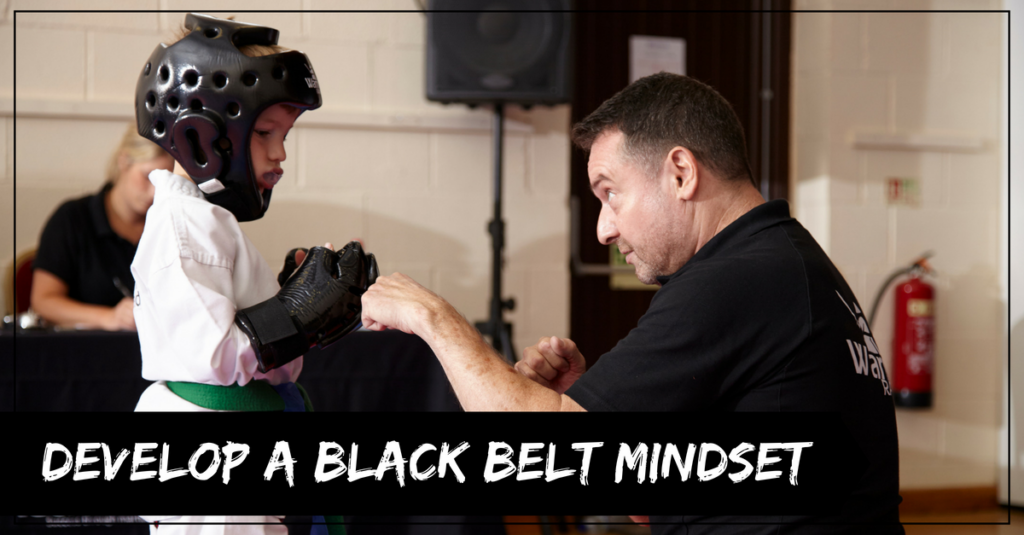
Who is coaching your child when nobody else is around? Not their teacher, not their martial arts instructor and not you. It is the voice inside their own head. That inner voice decides whether they keep going or give up, whether they try the hard maths question or leave it blank, and whether they shrug off a setback or decide they are just not good enough.
At The Warrior Academy we call a strong, positive inner voice the Black Belt Mindset. This article explains what it is, why it matters so much for resilience, and the practical ways parents in Dubai and Abu Dhabi can help their children build it at home.
Your child’s most important coach is their inner voice
Great mentors make a huge difference. They inspire children, bring out their best and help them grow as whole people. But every one of us also has a mentor that never leaves: the inner voice that reviews our performance, tells us what we did right and wrong, comforts us when things are hard and gives us the push to step up, face a challenge and keep going through routine.
For many people, sadly, that voice is mostly negative. It doubts, criticises and drowns out encouragement. Questioning ourselves is natural, but when the inner critic is in charge it can kill motivation and confidence. This often becomes more obvious during big transitions such as the move to secondary school and the teenage years.
What a black belt mindset looks like
A black belt is not someone who never fails. It is someone who has failed many times and kept training. A child with a Black Belt Mindset:
- sees mistakes as part of learning, not proof that they are no good;
- says things like I cannot do this yet, rather than I cannot do this;
- keeps going when something is difficult or boring;
- is happy to be pushed and enjoys a challenge;
- can talk themselves through nerves before a test, a performance or a grading.
What true resilience looks like
Our founder, Sebastian Bates, has always been inspired by survival stories. Ernest Shackleton and his crew were stranded in the Antarctic ice for well over a year and every man survived. The 33 Chilean miners trapped deep underground in 2010 held on for 69 days until they were rescued. In stories like these, survival depends on people who refuse to give up and keep pushing forward. That is grit and perseverance, and it starts with the voice inside.
Most children will never face anything so extreme, but the same principle applies to a tricky exam, a falling out with friends or a tough training session. Children who can coach themselves through difficulty have an enormous advantage, at school, in sport and later in their working lives. The good news is that this inner coach can be trained, just like a kick or a block.
How The Warrior Academy builds a positive inner voice
We spend a significant amount of time on this in The Warrior Method. Whether a student stays with us for one month or ten years, our goal is to leave them with lessons that last a lifetime, and a positive inner voice is one of the most important.
- Mat chats. Instructors regularly talk with students about noticing their inner voice and changing its direction when it turns negative.
- Challenging unreasonable doubt. Students learn to question the negative voice and spot when it is simply not true.
- Comfort zone challenges. Students are regularly stretched just beyond what they think they can do, so they collect proof that impossible is often just an opinion.
- Rewarding perseverance, not just results. We praise effort, persistence and courage, not only who won or who got it right first time. This teaches children that pushing through is what counts.
You can read more about the wider approach on our character development page.
How to build a black belt mindset at home
Ages 4 to 6
- Praise effort out loud: you kept trying even when it was hard.
- Read stories about characters who fail and try again, and talk about how they felt.
- Teach one simple phrase for hard moments, such as I can do hard things.
Ages 7 to 9
- Introduce the word yet. When your child says they cannot do something, add yet to the end of the sentence.
- Share your own mistakes and what you learned from them.
- Set small goals together, such as learning a new skill in four weeks, and track the practice, not just the result.
Ages 10 to 13
- Help them notice their self talk. Ask what their inner voice said before a test or match, and whether a good coach would say the same.
- Encourage them to take on something genuinely difficult, such as a grading, a competition or a performance.
- After setbacks, ask three questions: what went well, what would you change, and what will you try next time?
Teenagers
- Give them responsibility, such as helping younger children, and let them own the result.
- Talk about people they admire and the setbacks those people overcame.
- Resist rescuing them from every difficulty. Support them, but let them do the work.
Phrases to use, and phrases to avoid
The way adults talk to children often becomes the way children talk to themselves. Try swapping:
- You are so clever for you worked really hard on that.
- Do not worry, it is easy for this is tricky, and I know you can figure it out.
- Never mind, you are just not sporty for what could you practise to get better at that?
Frequently asked questions
Is a black belt mindset the same as a growth mindset?
They are closely related. A growth mindset is the belief that ability can be developed through effort. The Black Belt Mindset puts that belief into action through training, challenges and a positive inner voice that keeps a child going when things get hard.
At what age can children start building resilience?
From a very young age. Even toddlers can learn to keep trying, which is why our Little Warriors programme starts at around two years old, and our junior programme builds on it as children grow.
How does martial arts help children with self belief?
Martial arts gives children clear goals, regular challenges and visible progress through the belts. Each step proves to them that effort works, which is the foundation of a positive inner voice.
Start building your child’s black belt mindset
Want to know where your child’s confidence and resilience are today? Take our free Breakthrough Area assessment, then book a VIP Pass at your nearest academy in Al Quoz, Arjan, Jumeirah Islands or Abu Dhabi.