

Character Development: Your Child’s First 90 Days at Warrior Academy UAE
Every black belt started exactly where your child is now, standing at the edge of a mat with no idea what comes next. Over the years (and working with thousands of students), we have refined what those first 90 days look like into a clear process. This guide walks through what the average journey looks like, from the assessment session before Day 1 through to your child’s first belt grading, so you know exactly what to expect at every stage.
To help understand the journey, let’s break it down into four stages. Progress is always personal rather than tied to a rigid timeline, but the structure is the same for every student. It is built on The Warrior Method, our approach to character development that treats martial arts as a vehicle for building confidence, conduct, and concentration in children, not just technical skill.
Before Day 1: the Breakthrough Area Assessment
Before your child’s first full class, we conduct a Breakthrough Area Assessment. This evaluates your child across the three areas at the core of everything we teach:
- Confidence: how they carry themselves, respond to challenge, and engage with others
- Conduct: their behaviour, self-control, and ability to follow structure
- Concentration: their attention span, ability to listen, and follow-through on instruction
These are the 3 C’s that every class is built around. The assessment identifies your child’s personal breakthrough area and gives us the information needed to structure their first three to six months with a clear plan, rather than a generic one.
This introduction provides us with all the background we need to create a personalised progression plan and ensure your children develop at their own pace.
Phase 1: Days 1 to 30 — Foundations
Week 1: The First class
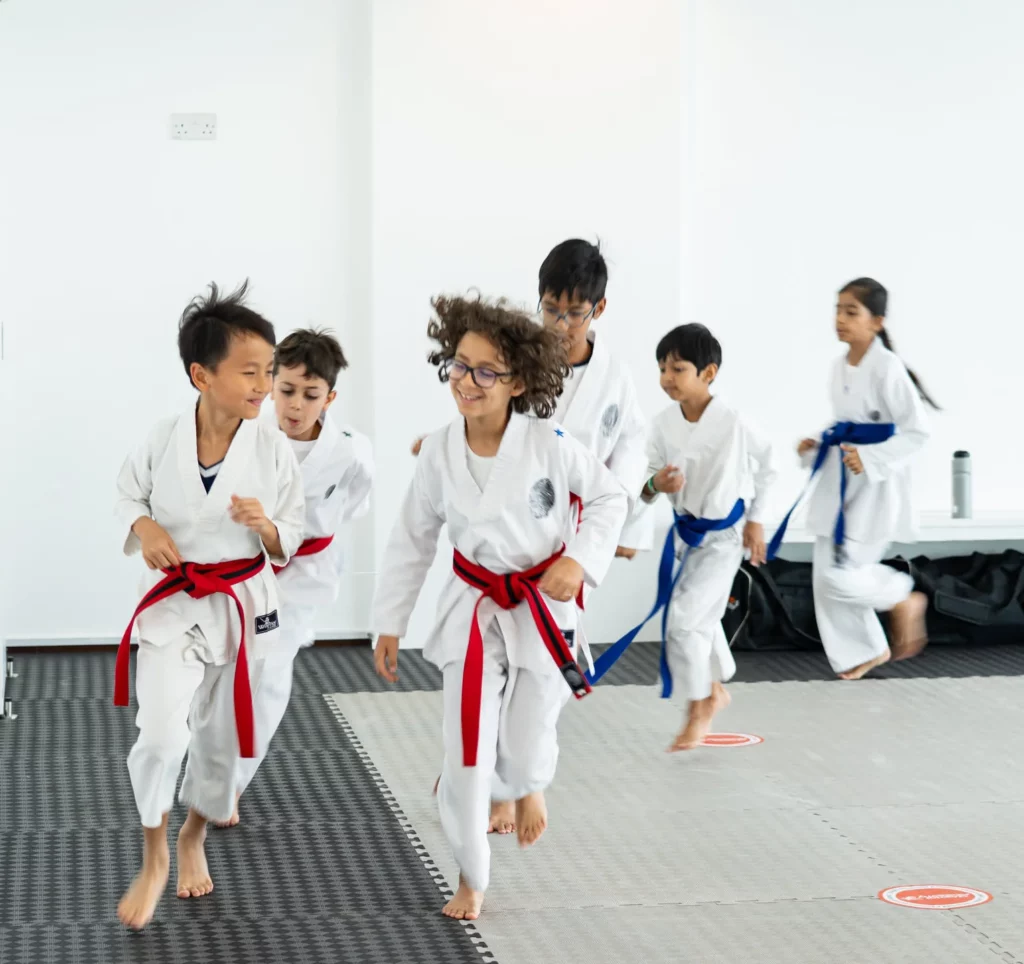
Your child will be welcomed by their instructor and introduced to the group. Classes at Warrior Academy are deliberately kept small, with one to two professional instructors per session, so every child receives genuine individual attention from the very first class. The aim in week one is to make your child feel comfortable and curious, not to perfect technique.
This is the Community stage of the Warrior Method at work. Confidence grows in the right environment, and the priority is making sure your child feels supported, seen, and safe to try things they are not sure about yet.
- Introduction to dojo etiquette: bowing, listening, and respecting training partners
- Basic stance and footwork, the building blocks that every technique is built upon
- First experience of the confidence-building warm-up routine
- Parents receive a take-home guide explaining what is being taught and how to reinforce it at home
Weeks 2 to 4: Core techniques
By the end of the first month, most students have a working foundation in the specific kicks, blocks, and movements that form the basis of their first belt. Alongside the physical side, instructors are tracking each child’s progress and many parents tell us the biggest change they notice in month one is not on the mat at all.
Children start carrying themselves differently, with better posture, more eye contact, and a calmer response to frustration.
Phase 2: Days 31 to 60 — Building Confidence
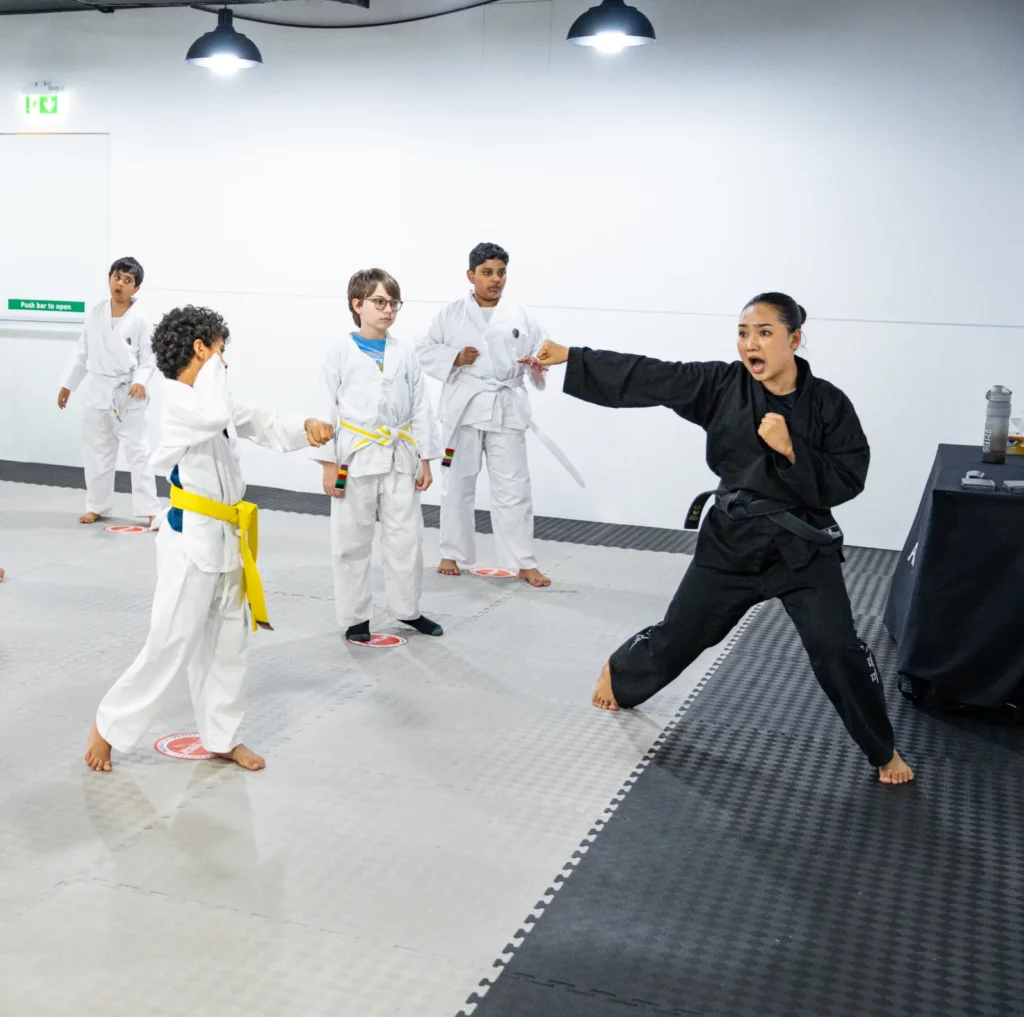
Around weeks five and six, techniques that felt awkward begin to flow. The dojo stops feeling unfamiliar and starts feeling like your child’s space. Friendships form, and training partners become a source of motivation. This is where your child begins to see a version of themselves, they want to work towards, and training becomes something they choose rather than something they are taken to.
- Combinations extend to multi-move sequences
- Students begin working towards defined technique milestones
- Goals are introduced, giving students a short-term target to train towards
- Students are given one-to-one instructor feedback sessions on strengths and weaknesses
By month two, students are guided from their comfort zone into challenging themselves. Techniques require genuine effort. Stripes have to be earned. The difficulty is the point.
Parents typically report visible changes at home during this period: improved listening, stronger focus, a shift in how their child responds to frustration and setback. This is character development in action, not as a concept but as something seen in everyday behaviour.
Phase 3: Days 61 to 90 — Preparation
Belts are a big part of character development and show tangible growth. Your child’s timeline is their own, so this step may occur in the first 90 days. If it does, your child must meet a range of criteria including regular attendance, and a consistent record of good behaviour and focus in class. Instructors confirm readiness individually. We do not put a child forward unless we are confident they will pass.
From around week nine, classes shift into formal martial arts grading preparation for kids. Students take responsibility for their own performance and begin to demonstrate what they have built.
- Syllabus review: all techniques from the first 90 days of martial arts consolidated and refined
- Mock grading scenarios in class to build familiarity and take the edge off nerves on the day
- Conduct and concentration are assessed alongside technique: grading looks at the whole student
- Parents are briefed on grading day requirements, what to bring, and how to support at home
Grading day is a milestone for the whole family. The experience of setting a meaningful goal, working towards it consistently, and achieving it through their own effort is what stays with your loved ones long after the belt is tied.

The Graduation Ceremony
Depending on your child’s journey and timeline, you will eventually experience the graduation ceremony. Results are not given on grading day. Instead, students who have passed take part in the Graduation Ceremony during their normal class. This is when the new belt is presented in front of the group.
Once the first belt is awarded, a new syllabus is introduced and new goals are set. Warrior Academy’s full belt pathway, registered with the WKF (World Karate Federation) and the UAE Karate Federation, leads all the way to black belt. Our students stay for an average of six or more years, not because they have to, but because the journey keeps giving them something worth working towards.
The Warrior Method: the four steps behind character development
Every stage of the 90-day journey maps onto the four-step framework at the heart of the Warrior Method:
- Community: placing your child in a small, structured, and supportive group where they feel safe to try. Confidence begins here.
- Inspire: building a clear vision of the journey and helping your child believe the destination is genuinely within their reach.
- Challenge: guiding students into performance and growth through belt progressions, goal cycles, and skill-based challenges that stretch without overwhelming.
- Lead: giving children responsibility through leading parts of class, setting goals, and preparing for martial arts grading for kids.
Ready to start your child’s journey?
Start with a trial class at your nearest Warrior Academy dojo. We have dojos in Al Quoz, Arjan, Abu Dhabi, and the Jumeirah Islands.
Ready to see the change in your children? Book an introductory lesson today, or explore our kids’ martial arts programmes to find the right class for your child’s age and stage.
Frequently asked questions
What is the Breakthrough Area Assessment, and does my child have to do it?
The Breakthrough Area Assessment is the starting point of your child’s journey. It evaluates their confidence, conduct, and concentration so we can build a personalised plan for the first three to six months rather than using a generic approach. It is part of the Introduction Experience, and we strongly recommend it before starting a regular programme.
What are the requirements to be invited to grade?
There are several requirements, including regular attendance across the grading period, and showing consistently good behaviour and focus in class. All three must be in place before an invitation is extended.
What if my child is not invited to grade this time?
Not being invited is useful feedback, not a failure. Speak with your child’s instructor after class and they will identify the specific area to focus on before the next cycle. We always encourage students to attend during grading week, regardless: the sessions are among the most technical of the term and excellent preparation for when their time comes.
How long does it take to earn the first belt at Warrior Academy?
Most beginners who train consistently, typically two to three sessions per week, are ready for their first grading within 90 days. The timeline is always individual: instructors confirm readiness when your child is genuinely prepared, not before.
What age can children start at Warrior Academy UAE?
Warrior Academy runs age-specific programmes from age 2 upwards. Little Warriors classes are designed for young children, building basic motor and social skills, while Junior, Senior, Pre-Teen, and Teen programmes cater to progressively older age groups. Family classes run at all UAE dojo locations, too.
Is Warrior Academy’s belt system recognised outside the UAE?
Yes. Warrior Academy is regulated by the WKF (World Karate Federation) and the UAE Karate Federation, so belt grades are recognised internationally. The Academy uses its own grading system with additional intermediate grades, giving students more frequent milestones than standard belt systems. More detail is in our belt progression guide.