

The tablet timer goes off. Thirty seconds later the controller is on the floor, a door has slammed and a younger sibling is in tears. You feel your own temper rising, and part of you wants to shout louder than they did.
Almost every family has a version of this moment. The good news is that handling anger is a skill, and skills can be taught. This guide covers what anger is really telling you, a step by step plan for the middle of a meltdown, the words that calm things down (and the ones that make it worse), how it changes with age, and a game to practise when everyone is calm.
What anger is really telling you
Anger is a normal, healthy emotion. The goal is not a child who never gets angry. The goal is a child who can feel angry and still choose what to do next.
In children, anger usually sits on top of something else. Look underneath for:
- Tiredness or hunger, especially after a long school day and a packed afternoon of activities.
- Disappointment, such as losing a game or a plan changing.
- Embarrassment, often in front of friends or siblings.
- Feeling powerless, when adults make every decision.
- A sense of unfairness, which is huge for children from about seven upwards.
Once you can see what is underneath, you can respond to the cause rather than just the explosion. Dubai life adds its own pressure points: long days, late dinners, summer weeks stuck indoors, and the upheaval of friends moving away or a family move to a new school.
In the moment: five steps that work
- Get calm first. Lower your voice, slow your movements and get down to your child’s level. A child cannot borrow calm from an adult who does not have any.
- Keep everyone safe. If they are hitting or throwing, step in without a lecture. “I won’t let you hit. I’m moving the controller.”
- Name the feeling, briefly. “You’re really angry that the game ended.” “That was so frustrating. You worked hard on that tower.” Feeling understood takes the heat out quickly.
- Offer a way to bring it down. “Let’s take three big breaths together.” “Do you want to squeeze this cushion or stamp your feet?” “I’ll sit here until you’re ready.”
- Repair later, not now. Once everyone is calm, perhaps an hour later or at bedtime, talk it through. “What happened? What could you try next time? Is there anything you need to put right with your sister?”
Words that pour fuel on the fire:
- “Calm down!”
- “Stop being so dramatic.”
- “You’re such an angry child.”
- “Carry on and there’s no iPad for a week.”
Words that help:
- “I’m here.”
- “You’re allowed to be angry. You’re not allowed to hurt.”
- “Your body looks really tense. Let’s breathe.”
- “Do you want a hug or some space?”
- “I get it. That felt unfair.”
What changes with age
2 to 3: Tantrums are normal because feelings arrive faster than words. Keep things simple: safety, comfort and a change of scene. Distraction works well at this age.
4 to 6: Children can learn names for feelings and one calm down tool, such as a deep breath or a hug from a favourite toy. Practise the tool when they are happy, not only when they are upset.
7 to 9: Anger often centres on fairness and losing, whether in games, sport or arguments with siblings. Help them see that losing is part of getting better, and let them help design their own plan. As our founder Sebastian Bates told Khaleej Times, “But between the ages of 7 and 13 is where growth becomes exponential. That’s when identity locks in.” The way a child learns to handle big feelings in these years tends to become part of who they are.
10 to 12: Embarrassment drives a lot of anger now. Avoid big conversations in front of others. Many children this age talk more easily side by side, on a walk or in the car, than face to face.
13+: Respect their need for space. Agree a signal that means “I need ten minutes”, and come back to the conversation later. Do not try to win an argument while both of you are angry.
Mistakes that keep the cycle going
- Matching their volume. Shouting teaches that shouting is how adults handle anger.
- Giving in to stop the scene. Handing over the treat in the middle of a busy mall ends the noise today, but teaches that anger works.
- Punishing the feeling. Being angry is fine. Hurting people or breaking things is not. Keep consequences for the behaviour.
- Lecturing mid meltdown. An upset brain cannot take in reasoning. Save the talk for later.
- Never talking afterwards. The repair conversation is where the learning happens.
- Sudden transitions. Switching off a screen without warning is a common trigger. Give a five minute warning and use a timer so the timer is the bad guy, not you.
If you lose your temper, say sorry. “I shouted, and that wasn’t okay. I’m going to try again.” It shows your child exactly what repair looks like.
If outbursts are very frequent, very intense, involve hurting themselves or others, or are worrying you, speak to your child’s doctor or school.
Practise when calm: the anger thermometer
Draw a thermometer on paper with five levels: 1 calm, 2 annoyed, 3 frustrated, 4 angry, 5 explosive. Together, describe what each level feels like in the body: a hot face, tight fists, a fast heart.
Then choose a tool for each level:
- At 2, tell someone how you feel.
- At 3, take three dragon breaths: in through the nose, then a long, slow breath out like a dragon breathing fire.
- At 4, go to an agreed calm spot.
- At 5, an adult helps.
Stick it on the fridge. For one week, practise dragon breaths every day as a game and see who can make the longest out breath. Rate characters in films or books on the thermometer too. Then, when a real moment comes, all you need to ask is “Where are you on the thermometer?”
Signs your child is getting better at this
- Meltdowns get shorter, and recovery gets quicker.
- They use words before actions: “I’m so angry!”
- They reach for a calming tool without being prompted.
- They come back to apologise on their own.
- They can lose a game without wrecking it for everyone else.
Expect setbacks when your child is tired, unwell, jet lagged after a trip home or settling into a new school. Progress is rarely a straight line.
How we work on this on the mat
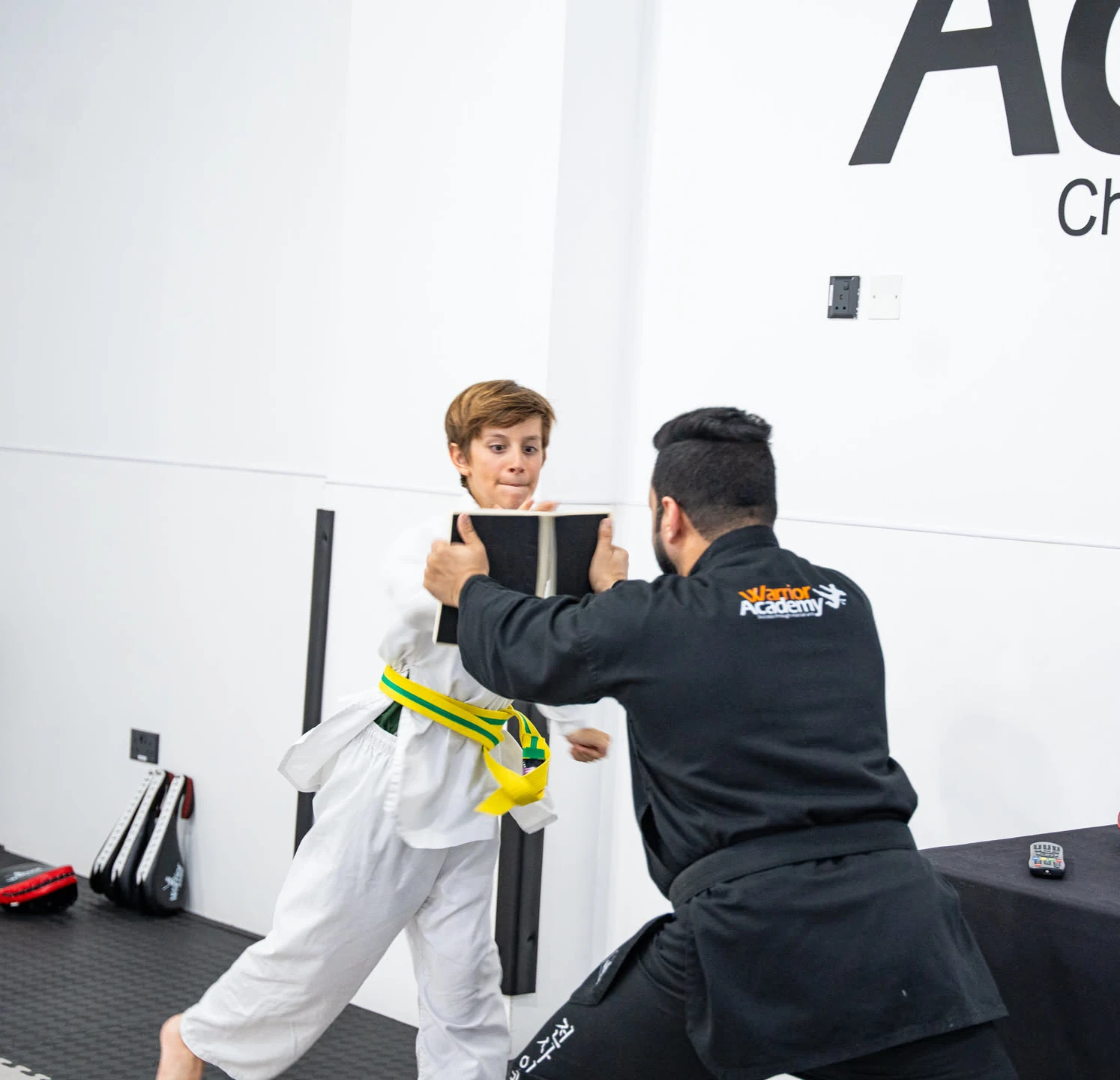
Martial arts gives children a safe place to feel frustration, whether that is a technique that will not work yet or a partner who is quicker. Conduct is one of the 3 C’s taught in every class, alongside confidence and concentration. Self-defence follows the A.C.E system: Avoid, Control, Engage, so children learn that control comes long before anything physical. As Sebastian told Khaleej Times: “Skill without character is dangerous.” Our Senior Warriors classes for ages 7 to 9 are capped at 13 children, and every family has a monthly one-to-one call with their child’s instructor to share what is happening at home. Read more about our character development approach.
Frequently asked questions
Is it normal for an eight year old to have tantrums? Occasional outbursts are normal at any age, especially when a child is tired or overwhelmed. If they are very frequent or intense, speak to your child’s doctor or school.
Should I send my child to their room? A break can help if it is offered as a chance to calm down rather than a banishment. Younger children usually calm faster with you nearby.
What should I do if they hit me or a sibling? Step in calmly to keep everyone safe, comfort the child who was hurt, then deal with the consequence and the apology once everyone is calm.
Does martial arts make children more aggressive? A good class does the opposite. Children learn control, respect and that physical skills are only for protecting themselves and others.
How do I stay calm myself? Have your own plan: breathe out slowly, step back and lower your voice. It is fine to say “I need a minute” before you respond.
Be the calm in the storm
Every meltdown you handle calmly is a lesson your child keeps for life. If you would like to see how we teach control on the mat, Book a class.