

Three squares from the finish of snakes and ladders, your child lands on the longest snake and slides all the way back to the start. Ten seconds later the board is on the floor, the counters are under the sofa and someone is in tears. Swap the board game for a football match, a school sports day or a spelling test, and the same thing can happen at eleven as at four.
Learning to lose is one of the hardest skills childhood asks for, and one of the most useful. This guide covers how to teach kids to lose gracefully: what is normal at each age, how to prepare them before a game, what to say in the moment and afterwards, and some games that let them practise losing safely at home. It covers winning well too, because that matters just as much.
What is normal at each age
Knowing what is typical stops you from overreacting to a stage that will pass.
Ages 2 to 3. Toddlers do not really understand winning yet. They want the turn, the toy, the attention. Keep games cooperative and very short.
Ages 4 to 6. This is peak meltdown age. Children now understand winning and losing but do not yet have the self control to handle the feeling. Tears, quitting halfway and changing the rules are all common. It is not a character flaw. It is a skill still being built.
Ages 7 to 9. Fairness and rules matter enormously. Losing often comes out as “That’s not fair!” or “You cheated!” Children this age can learn to name the feeling and follow a plan.
Ages 10 to 12. Losing in front of friends is the hard part. They may act like they do not care, or blame teammates, the referee or the equipment.
Teens, 13 and up. Losing becomes tied to identity: “I’m just not good at this.” The conversation moves from behaviour to how they talk to themselves.
Before and during the game: set them up to cope
Good sportsmanship is mostly built before the game starts.
- Agree what happens at the end. “Before we start: whoever loses says ‘good game’, and then we can play again.”
- Name the feeling ahead of time. “You might feel cross if you lose. That’s OK. What can you do with that feeling?”
- Give them a plan. Three slow breaths, squeezing their fists tight and letting go, or walking to the kitchen for a drink of water.
- Stay calm and brief in the moment. “You’re really disappointed. Breathe with me.” Save the lesson for later. A child in the middle of a meltdown cannot learn anything.
- End the game if things get thrown. Calmly, with no lecture: “We stop when things get thrown. We can try again tomorrow.”
Our founder Sebastian Bates puts preparation at the centre of this. As he says on The Warrior Academy Podcast: “But confidence is not built by comfort. It is built by preparation.” Children who have rehearsed losing cope far better when it happens for real.
After the loss: the conversation that counts
Wait until everyone is calm, maybe at bedtime or in the car on the way home from a match. Then:
- Acknowledge the feeling: “You really wanted to win that one.”
- Notice the effort: “You kept trying even when you were behind.”
- Ask rather than tell: “What would you do differently next time?”
- Point to the next chance: “Rematch tomorrow?”
A few swaps that help:
- Instead of “It’s only a game”, try “It matters to you, and that’s why it hurts.”
- Instead of “You were robbed”, try “That decision didn’t go your way. What can you control next time?”
- Instead of “Never mind, you’ll win next time”, try “What’s one thing you got better at today?”
- Instead of “Good job” after a win, try “You stayed focused right to the end.”
Teaching them to win well
A child who gloats is learning the same lesson from the other side. Teach winners to:
- Shake hands or say “good game” first.
- Keep celebrations short and out of the other person’s face.
- Say something kind about their opponent: “Your last move was really clever.”
Model it yourself. When you beat your child at a game, say “That was close, you nearly had me”, not “Ha, I win again.”
Common mistakes parents make
- Always letting them win. It feels kind, but it means losing still feels like a disaster when it finally happens at school. Let younger children win sometimes, not every time.
- Blaming the referee or the coach. Children copy how you talk on the sidelines, and in the car afterwards.
- Rescuing too fast. Rushing in with a treat to stop the tears teaches that bad feelings need someone else to fix them.
- Only praising results. If medals and trophies get the most attention, losing feels like failing as a person. Sebastian told Khaleej Times: “Too many places chase belts and trophies.” Families can fall into the same trap without noticing.
- Avoiding competition altogether. Children need small, safe losses to practise on before the big ones arrive.
Practise losing at home
- The deliberate loss. Lose a game on purpose and narrate it out loud: “Oh, I lost. I’m a bit disappointed. Good game. Shall we play again?” Children learn more from watching you lose well than from any talk.
- The good game rule. Everyone, every time, win or lose, says “good game” before the box goes away.
- Luck games first. Snakes and ladders and simple card games like snap are perfect practice, because nobody can be blamed for luck.
- Beat your best. For children who really struggle, compete against their own score: how many catches in a row, or how fast they can get their shoes on. Over the indoor summer months, a weekly family games night can do a lot of this work.
You will know it is working when:
- Meltdowns get shorter, even if they still happen.
- Your child says “good game” without being prompted.
- They ask for a rematch instead of quitting.
- They talk about what they learned, not just the score.
- They are kinder when they win.
How we work on this on the mat
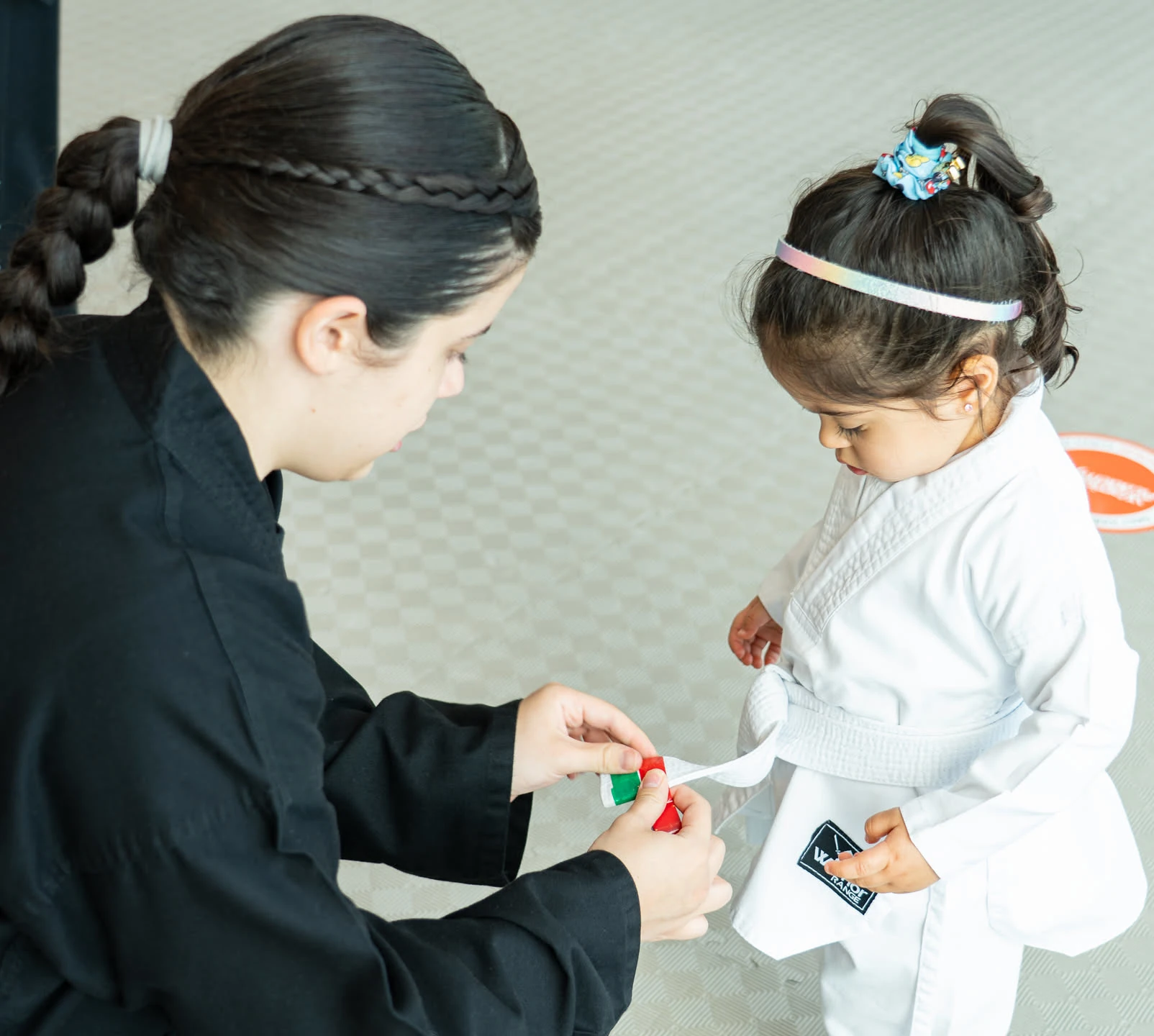
Martial arts gives children a regular, supervised place to win, lose and try again. In our Sparring programme, children practise with partners, and not every round goes their way. That is the point. Every session teaches the 3 C’s: Confidence, Conduct and Concentration, so how a child behaves after a tough round matters as much as their technique. Gradings are registered with the WKF and the UAE Karate Federation, so belts are something children work towards. Groups are kept small, and we stay in close touch with parents, so do talk to us about how your child handles setbacks. For younger children, Senior Warriors (ages 7 to 9) is a good place to start.
Frequently asked questions
Should I let my child win at board games? Sometimes, especially under 5. As they get older, let the real result stand more often so they get used to losing in a safe place.
My child cries every time they lose. Is that normal? For 4 to 6 year olds it is very common. Keep games short, prepare them beforehand and stay calm. If the upset seems extreme or shows up in lots of other areas, speak to your child’s doctor or school.
How do I stop my child blaming others when they lose? Gently bring it back to what they can control: “Maybe. What’s one thing you could do differently next time?” Avoid arguing about whose fault it was.
Is competitive sport good for children who hate losing? Often, yes. A well run activity gives them lots of small, safe losses to learn from, with adults who help them handle the feelings.
Every loss is practice
The child who learns to say “good game” through gritted teeth at seven is building something they will use for the rest of their life. If you would like to see how we handle winning and losing on the mat, Book a trial experience.