

Martial Arts Safety: How Warrior Keeps Your Child Protected
When parents consider enrolling their child in martial arts classes, safety naturally tops the list of concerns. Take a look at how our team at Warrior Academy creates a safe, supportive environment where children can develop confidence and skills without unnecessary risk.
Safety By Design
Safety in martial arts isn’t a tickbox; it’s a fundamental part of all combat sports. From the moment students step onto the mat to the techniques they learn, layers of protection work together. At Warrior Academy, this means basing what we do on the principle that martial arts classes for kids should build up students, physically, mentally, and emotionally, without putting them at risk.
Age-Appropriate Training Design
Children develop differently across stages, and our programmes reflect this. Each age group follows a specifically designed curriculum that matches their physical development, coordination, and understanding.
Children (Ages 4-7): This training focuses on body awareness, basic movements, and controlled play-based learning. Contact is minimal and heavily supervised, with an emphasis on rolling, falling safely, and understanding personal space. Classes use games and drills that build coordination without impact.
Preteens (Ages 8-12): As children develop better control, we introduce controlled partner drills with protective equipment. Our preteen training emphasises leverage and positioning rather than force. Students learn breakfalls and defensive movements before any contact-based training begins.
Teens (Ages 13+): Teen training includes more realistic training scenarios whilst maintaining strict safety protocols. Protective gear is mandatory for all contact drills, and students progress through clearly defined skill levels before advancing to more challenging techniques.
Family Classes: Mixed-age family sessions are carefully structured so participants work with appropriate partners and modify techniques based on size and experience differences.
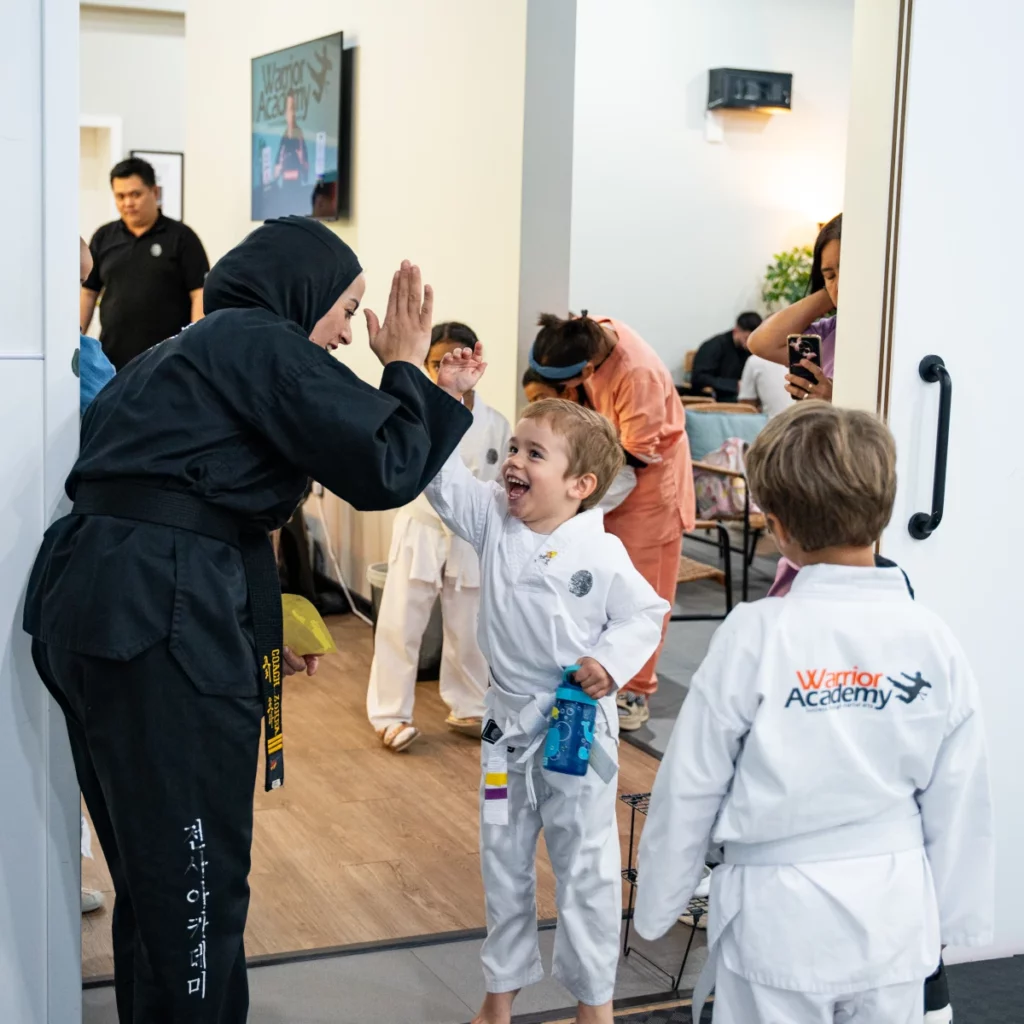
Instructor Qualifications
Every Warrior Academy instructor undergoes extensive training beyond martial arts technique. Our teaching team holds:
- Certified coaching qualifications in their respective disciplines (Brazilian Jiu-Jitsu, Muay Thai, and MMA)
- First aid and CPR certification, renewed regularly
- Child safeguarding and protection training
- Specialised training in age-appropriate teaching methods
- Ongoing professional development through regular workshops
This is all supported by our founder, Sebastian Bates’s, 20 years of martial arts experience and work with UAE youth football academies, which informs our teaching approach. Our instructor-to-student ratios are deliberately small, so every child receives supervision and individual attention during training.
Protective Equipment Standards
Along with the students, our space is monitored too. We maintain strict equipment requirements that vary by age group and training intensity:
Required Equipment:
- Properly fitted martial arts uniform (gi) for all students
- Mouthguards for any contact-based drills at older levels
- Protective headgear, gloves, and shin guards for sparring sessions
All our protective gear meets international safety standards, and we provide guidance on proper fitting and maintenance. Students cannot participate in contact activities without appropriate equipment, no exceptions.
Facility Safety Features
Our UAE training facilities are also purpose-built for martial arts with safety in mind:
- High-quality impact-absorbing mats covering all training areas
- Clear training space free from obstacles and hazards
- Climate-controlled environment to prevent heat issues in the UAE’s extreme conditions
- First aid stations are readily accessible for any and all emergencies
- Regular equipment inspections and maintenance schedules
Progressive Skill Development
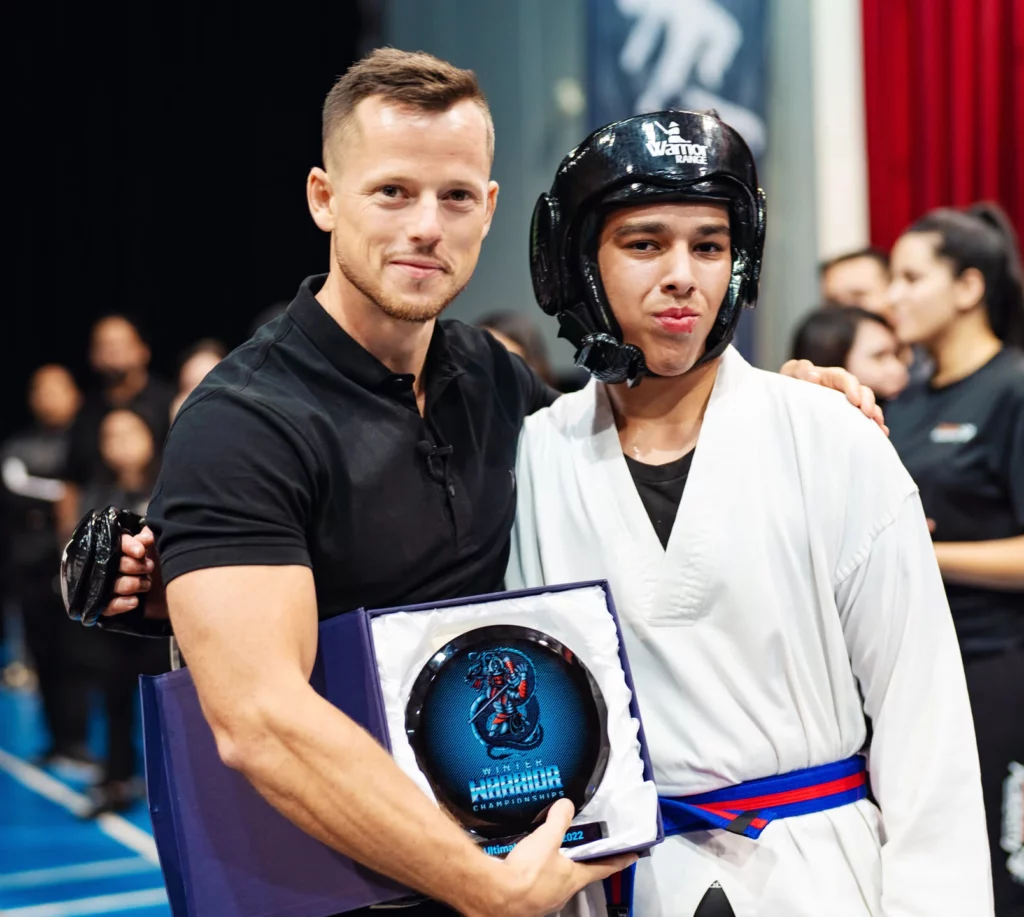
A core part of our training is that students do not advance to more challenging techniques until they have mastered foundational skills.
Our belt system isn’t just about recognition; it’s a safety mechanism that ensures students have the physical control and understanding necessary before learning advanced movements.
Before any student practises a new technique with a partner, they:
- Learn the proper form through solo practice
- Demonstrate control to an instructor
- Practise with an instructor supervising closely
- Only then, work with a peer under continued supervision
This progression reflects our philosophy that martial arts is about personal growth and tenacity, not competition or aggression.
What Happens If an Injury Occurs
Despite best efforts, minor bumps and bruises can occasionally occur during physical activity. This is not limited to martial arts for kids and affects all sports. However, we’re prepared:
- Qualified martial arts instructors assess the situation immediately
- First aid is administered on-site for minor issues
- Parents are contacted immediately for any injury requiring attention
- Incident reports are completed and shared with parents
- Students receive modified training plans during recovery when appropriate
We have found that our incident rate is significantly lower than that of contact sports such as football and rugby, and serious injuries are extremely rare.
Building a Safety-First Culture
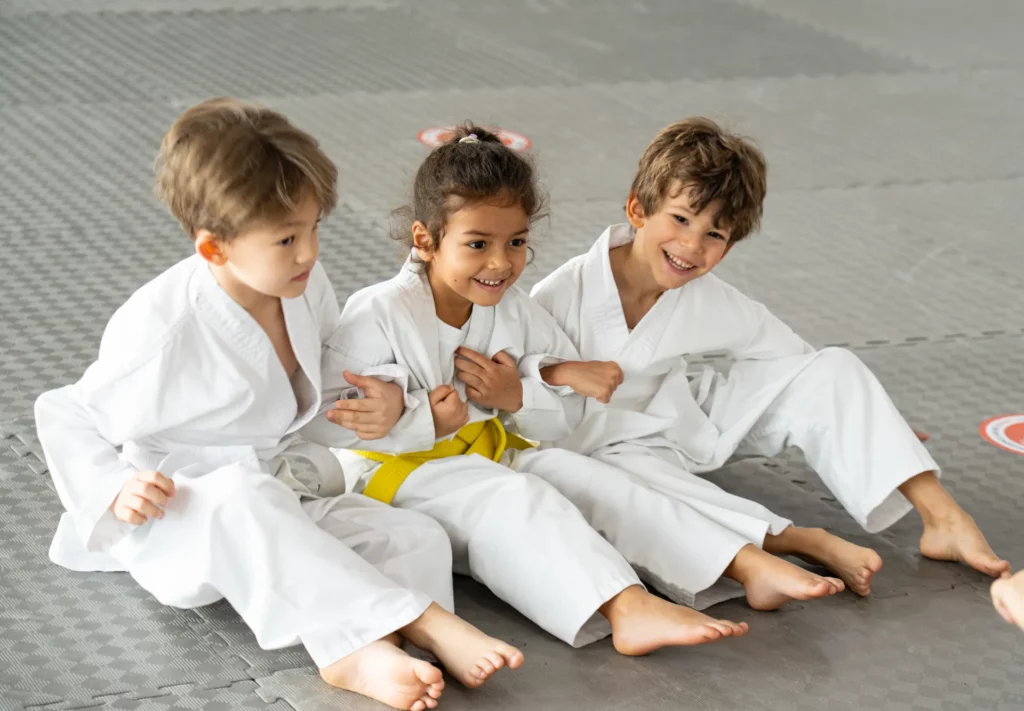
Beyond policies and equipment, we have made an environment where safety is everyone’s responsibility. Students learn to:
- Respect training partners and practice control
- Communicate immediately if something feels wrong or painful
- Follow instructions carefully and ask questions when unsure
- Look out for classmates and report unsafe situations
- Understand that “tapping out” or stopping is always acceptable
This culture of mutual respect and awareness creates accountability that supports our safety measures. It’s part of how we develop not just skilled martial artists, but respectful, confident young people.
Comparing Martial Arts Safety to Other Youth Sports
Research consistently shows that martial arts training, when properly supervised, has similar injury rates as other popular youth sports like football. What sets us apart is that we are prepared for the hits.
The controlled environment, emphasis on technique over force, and progressive skill development create inherently safer conditions than many team sports, where collisions and unpredictable movements are common.
Your Child’s Safety Is Our Priority
At Warrior Academy, we know that parents want to raise confident children. When you trust us with your child’s training, you’re joining a community that puts safety and wellbeing at the centre of everything we do.
We invite you to trial a class (be it for children, pre-teens, or teenagers) and speak with our instructors about any safety questions you have. We’re proud of our safety record and transparent about our practices.
Ready to see our safety standards in action? Book a free trial class for your child and experience the Warrior Academy difference firsthand. Contact us today to schedule your visit to one of our three UAE locations.