

The Path to Positive Change
Every parent dreams of seeing their child grow into a confident individual who can handle life’s challenges Yet, sometimes, small, persistent behaviour or ‘bad habits’ can feel like roadblocks on that journey.
This guide explores how helping children overcome bad habits is one of the best ways to build lasting self-confidence, discipline, and a proactive mindset. By understanding the psychology behind habit formation and applying proven strategies, you can empower your kids to become stronger physically, mentally, and emotionally and develop healthy habits.
Understanding the Roots of Bad Habits in Kids
Before we can talk about how to stop bad habits, it’s crucial to understand why bad habits form in the first place. These behaviours are rarely a sign of defiance; more often, they are a coping mechanism or a learnt response. For children and teens, especially in a high-achieving environment like the UAE, pressures can mount. Common triggers for bad habits include:
Stress/Anxiety: Nail-biting, fidgeting, or comfort eating can be unconscious responses to feeling overwhelmed by school or social pressures.
Boredom: In an age of constant stimulation, a lack of engaging activity can lead to habits like excessive screen time or snacking.
Seeking Comfort or Control: Repetitive actions can provide a sense of predictability and comfort in a world that often feels chaotic to a young person.
Mimicry: Children are excellent observers and often pick up habits, both good and bad, from parents, siblings, and peers.
Recognising that a habit serves a purpose is the first step. Instead of simply trying to eliminate the behaviour, the goal is to replace it with a more positive one.
The Martial Arts Mindset: A Framework for Healthy Habits For Kids
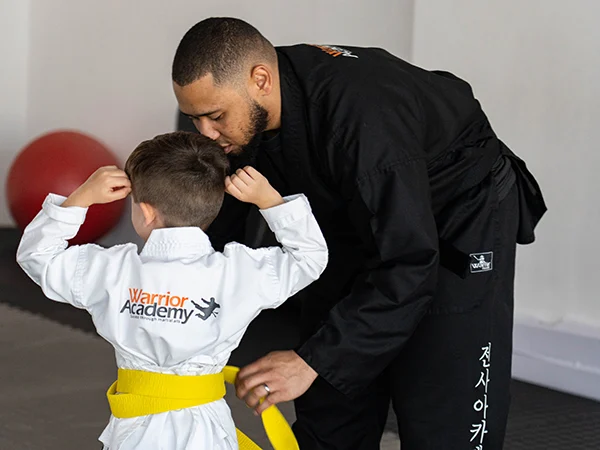
Imagine the journey of a martial arts student. They begin with a white belt, a symbol of a fresh start. Their ultimate goal is the black belt, a symbol of mastery that seems a long way away. They don’t achieve it overnight. Instead, your child progresses slowly and methodically, learning about what it takes to achieve their goals. What’s more, your child learns alongside their peers, discovering newer, healthier habits to emulate in their own lives.
This system works because it reframes a challenge into a series of manageable steps. A child doesn’t just ‘stop’ a bad habit; they earn their ‘yellow belt’ by managing it for a day, their ‘orange belt’ by succeeding for a week, and so on. This approach, known in developmental psychology as gamification, transforms the daunting task of change into an engaging and motivating game where the rewards are tangible, and the progress is visible.
Applying ‘Gamification’ to Overcome Bad Habits for Kids
Gamification is the application of game-design elements in non-game contexts to motivate and engage. The martial arts belt system is a perfect real-world example. However, it works with healthy eating, school work, and other activities too. Here’s an example of how this system can play out:
The ‘White Belt’ – Identify and Acknowledge
The journey begins with awareness. Sit down with your child and discuss the habit without blame or shame. Frame it as a challenge you can conquer together. The goal is to identify the habit and agree that it’s something worth changing.
The ‘Yellow Belt’ – Set the First Small Goal
The first goal should be incredibly simple to achieve. For example, if it’s leaving clothes on the floor, it could be putting them in the hamper for two consecutive days. Success here is vital for building initial momentum.
Create a Ladder of Progress
Map out a series of small, incremental goals. Each ‘belt’ should be slightly more challenging than the last. For example, reducing screen time might look like this:
- Yellow Belt: Finish homework before screen time for 2 days.
- Orange Belt: Stick to the agreed screen time limit for a whole week.
- Green Belt: Proactively choose a non-screen activity (like reading or playing outside) once a day for a week.
Celebrate Every Milestone
When your child achieves a ‘belt’, celebrate it! This isn’t about material rewards, but about recognition. Acknowledge their effort, praise their perseverance, and celebrate their success as a family. This positive reinforcement is the fuel that will keep them motivated for the next stage.
The Life Skills Forged by Conquering Bad Habits
When a child successfully changes a habit through this structured process, they are learning far more than just a new behaviour.
Building True Resilience
The path to breaking a habit is never a straight line. There will be setbacks. Just as a martial artist might not pass a belt grading on the first try, a child learns to see a slip-up not as a failure, but as feedback. Learning to acknowledge a mistake, reset, and try again without giving up builds profound mental toughness and resilience.
Mastering Goal-Setting
This process is a practical, hands-on lesson in how to achieve long-term objectives. Children learn to deconstruct a large, intimidating goal into a series of concrete, actionable steps. This skill in goal-setting is directly transferable to other parts of everyday life.
Developing Delayed Gratification
Bad habits often provide instant, easy rewards. The allure of one more video, one more biscuit, or putting off homework for a few more hours is powerful. In contrast, the reward for breaking a habit, increased confidence, better health, and improved grades, is delayed. By working towards these long-term benefits, children strengthen their ‘patience muscle’.

The Ripple Effect: How One Small Change Transforms a Life
The confidence a child gains from conquering a single bad habit doesn’t stay in isolation. It creates a positive ripple effect that touches everything. A child who learns to manage their procrastination and stay on top of their homework suddenly finds more time for hobbies and friends. A child who replaces excessive screen time with a physical activity not only improves their health but may also discover a new hobby and friend group.
What Parents Can Do
Be Supportive
As a parent, your role in this journey is not that of a disciplinarian, but of a supportive coach.
Lead by Example
Let your child see you working on your own habits. Talk openly about your challenges and your strategies for overcoming them.
Focus on Effort
Praise their consistency, their positive attitude, and their courage to try again after a setback.
Create a Positive Environment
If the goal is to eat healthier, stock the kitchen with nutritious snacks. Adjust the environment to make the good habit the easier choice.
Be a Partner, Not a Judge
Use ‘we’ language. ‘How can we remember our goal today?’ feels much more supportive than ‘Did you remember your goal?’. This frames it as a team effort.
Building a Foundation for a Lifetime of Success
Guiding a child through the process of breaking bad habits is one of the most important forms of character development. It’s not about creating a ‘perfect’ child; it’s about giving them the tools to become the champion of their own life. Each habit overcome is like a belt earned, a tangible symbol of their ability to set a goal, work through challenges, and achieve something meaningful.
These lessons in discipline, resilience, and self-belief build a foundation that will support them through academic pressures, career obstacles, and personal setbacks for years to come. If you’d like to see how martial arts can help with the process, sign up today. Our classes for children (junior and senior), pre-teens, and teens are a great grounding for change, offering a unique place for your children to grow alongside their peers. Try a session today, and see how you and your children can start breaking bad habits today.