

If your children have ADHD, you already know how draining the school week can be. Long days that demand quiet focus, classroom rules that punish movement, friendships that depend on impulse control, and homework battles that stretch into the evening.
We hear the same question from families every week: what activity actually helps a child with ADHD, rather than tiring everyone out?
Martial arts for children with ADHD is one of the most effective ways to help your child develop, and at Warrior Academy, it sits at the heart of how we work with children who learn and behave differently.
This guide walks parents through what ADHD looks like, how structured martial arts training supports focus, self-discipline, and emotional regulation, and what to look for when you’re choosing a programme for a child who needs more than a generic kids’ class.
What is ADHD?
Attention Deficit Hyperactivity Disorder is a neurodevelopmental condition that affects how children pay attention, manage impulses, and regulate energy. The World Health Organisation estimates that around 5% of children worldwide live with ADHD, and the condition is increasingly recognised across UAE schools, where teachers, healthcare workers, and other professionals are better trained than ever to identify it early.
Children with ADHD often struggle with sustained attention in classroom settings, sitting still through long lessons, following multi-step instructions, and managing the social cues that come with team sports. None of these is a character flaw. They are how an ADHD brain is wired. The right environment, with structure, movement, and clear expectations, can shift a child’s whole experience of learning and growing up. The NHS guide to ADHD in children is a good first read for parents who are still working out whether the label fits.
Concentration: How Martial Arts Trains Focus and Attention
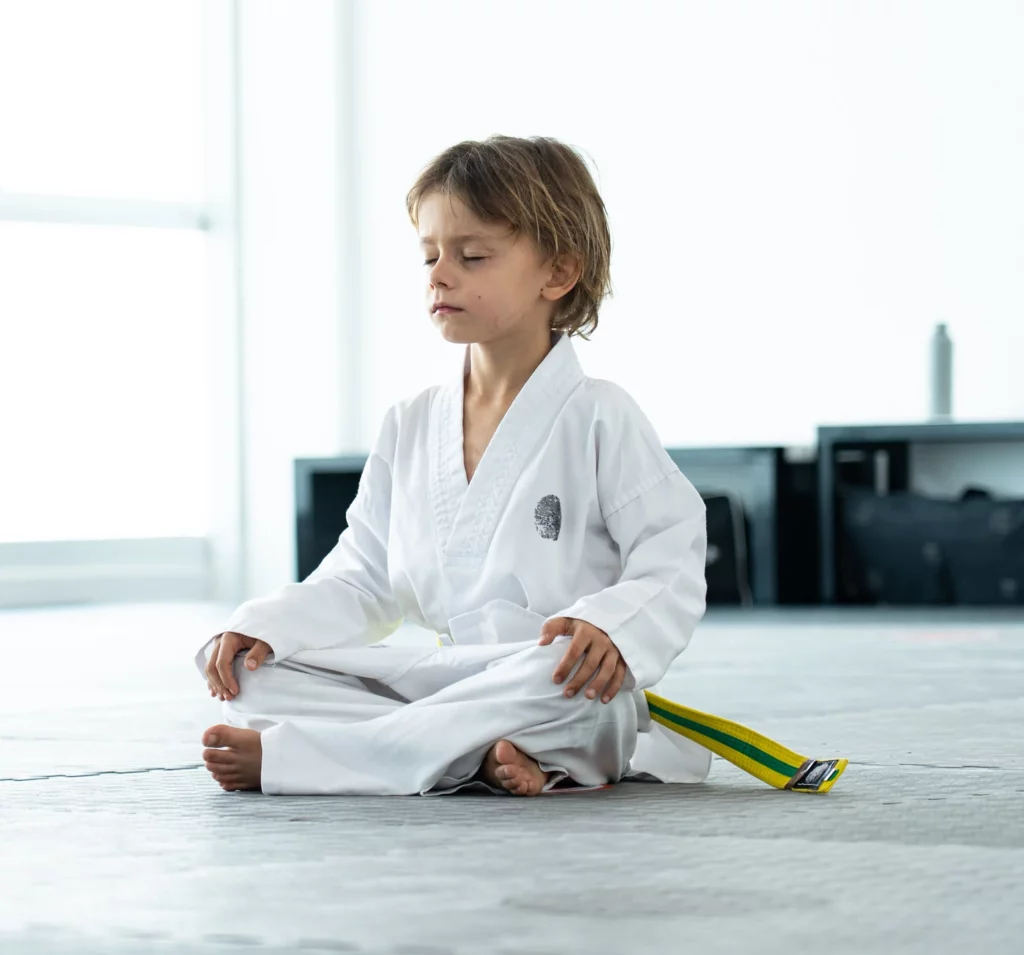
Concentration is one of the 3 C’s of the Warrior Method, our character development framework. We treat concentration as a skill that can be trained, and ADHD doesn’t change that; it just changes how the training has to be delivered.
Martial arts gives children small, achievable focus targets, sometimes only 10 to 30 seconds at a time, before resetting and repeating. Holding a guard, listening for a count, mirroring an instructor’s footwork, watching a partner’s hands during a drill. Each rep is a chance to practise paying attention, and the structure of the lesson, warm-up, technical drill, partner work, and cooldown, gives the ADHD brain the variety and pacing it responds to.
The discipline-specific tools matter too. Brazilian Jiu-Jitsu rewards patience and pattern recognition. Muay Thai builds rhythm through pad work and structured combinations. Breathing drills and short meditative resets between rounds give children a portable tool they can use in the classroom and at home. Over time, the focus children build on the mat starts to show up in their schoolwork, their conversations, and their ability to sit through an instruction without losing the thread.
Conduct: Building Self-Discipline and Self-Control
The second of our 3 C’s is Conduct; behaving with respect, responsibility, and integrity. For a child with ADHD, this is the area parents tell us they care about most. Impulsiveness is exhausting for everyone, including the child. Martial arts work on it directly.
Every class begins and ends with a bow. Children line up. They wait for their turn. They control where they hit and how hard, because contact training in a Warrior Academy class is structured, supervised, and never aggressive. The belt system gives children a long, visible runway of progress, and each promotion is earned through consistent behaviour as well as technical skill.
Add to this instructors trained to work with children, and we develop specialised grading systems that grow with your child. We will hold a child back a grade if their conduct in class isn’t where it needs to be, and that boundary teaches more than any lecture could.
Rules in martial arts are not arbitrary. They are tied to the safety of the partner you’re training with. Children with ADHD often respond to that logic in a way they don’t respond to “because I said so”. Once a child understands that self-control is what allows them to keep training, the motivation to develop it comes from the inside.
Movement, in a Climate-Controlled Environment
Children with ADHD need to move. Not occasionally, regularly. UAE summers make outdoor sports impractical for half the year, and most parents already know how quickly a hot afternoon turns into screens and snacks. Our dojos in Abu Dhabi and Dubai are climate-controlled year-round, which means your child can train at full intensity in July as easily as January.
Martial arts also sidesteps one of the harder problems in team sports for children with ADHD. Football, cricket, and basketball all reward children who can read fast-moving group play and stay patient when the ball isn’t in their part of the pitch. That is exactly the kind of sustained, distributed attention an ADHD brain finds hardest. Martial arts is different. Most of the work is one-to-one or in pairs, with a clear focus point in front of the child. The activity itself does some of the focusing for them.
The physical payoff is real. Fitness, coordination, balance, core strength, and spatial awareness all improve through regular training. Better sleep often follows, which improves daytime focus, which improves school performance, a positive loop that parents start noticing within a few months.
Confidence: The Social and Emotional Side
The third C is Confidence. Children with ADHD often arrive with their confidence already dented, the result of years of being the child who “won’t sit still”, “talks too much”, or “doesn’t try hard enough”. Martial arts gives them a place where their energy is welcomed, not corrected.
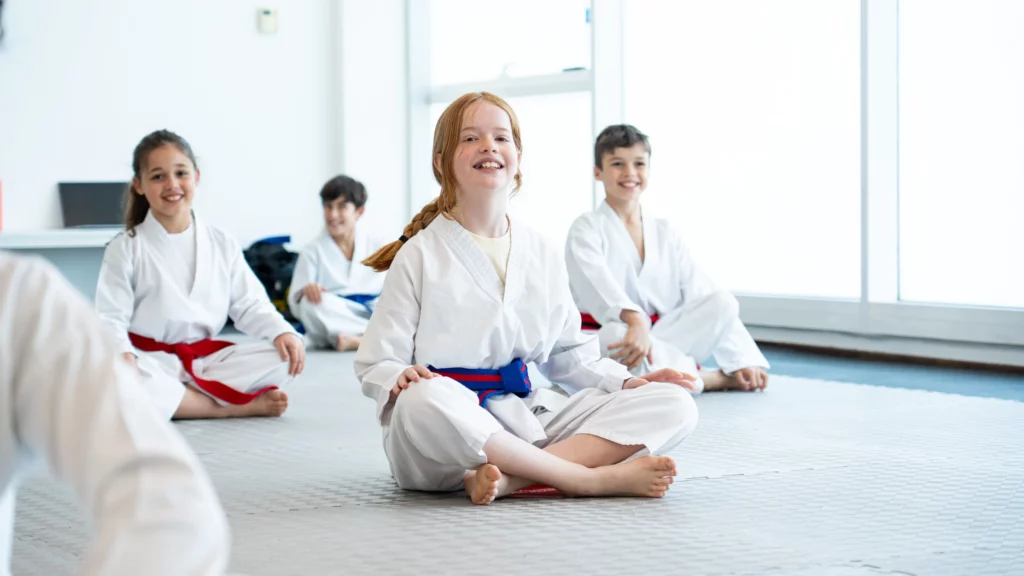
Our classes are small, capped at 13 students, meaning every child is seen. Our instructors know each child’s name, their belt, their current goal, and where they’re stuck. The friendships that build inside that environment are different from school friendships; they’re earned through shared effort. For children who find lunchtime difficult, that matters.
Belt promotions, demo days, and competition opportunities (for children who want them) give parents and children visible markers of progress. A nine-year-old who couldn’t get through a homework page in September is grading for a yellow belt by Christmas; that’s a different kind of confidence to anything school can give them. We see it again and again.
Choosing a Martial Arts Programme for a Child with ADHD in the UAE
Not every martial arts club is set up to support children with ADHD. When you’re researching options across Dubai or Abu Dhabi, look for:
- Small class sizes. A child with ADHD will not thrive in a class of 30. Warrior Academy caps every class at 13 students.
- Age-banded programmes. Mixing a six-year-old with a twelve-year-old rarely works for either. Our Junior Warriors (4 to 6), Senior Warriors (7 to 9), Pre Teens (10 to 12), and Teenagers (13+) classes are matched to developmental stage.
- Instructors trained in child development, not just martial arts. Ask how they handle a child who’s having a difficult day. The answer tells you everything.
- Clear progression and routines. Children with ADHD thrive on predictability. A class with the same warm-up, the same bow, the same expectations every week settles a child far faster than a “fun and varied” curriculum.
- A character-first philosophy. At Warrior Academy, character development comes before techniques. Founded by Sebastian Bates, the academy is built around the principle that martial arts teaches life skills beyond learning kicks and punches.
- Parent communication. We run regular one-to-one calls with parents to track each child’s character development. This is a genuine differentiator and matters most for ADHD families, where school feedback often stays narrow.
It also helps to visit. A trial class will tell you more than a website ever can.
Ready to See It in Action?
If you’re a parent in Dubai or Abu Dhabi looking for a structured, supportive activity for a child with ADHD, the easiest first step is to come and watch a class. There’s no pressure, just a chance to see how a Warrior Academy session actually runs.
Book a trial class at one of our four UAE Character Development Centres in Al Quoz, Arjan, Jumeirah Islands, or Abu Dhabi, or book an introduction call with our team if you’d like to talk through your child’s needs first.
Children with ADHD FAQs
- Is martial arts safe for a child with ADHD?
Yes, when the programme is set up properly. At Warrior Academy, every instructor is qualified in child safeguarding and first aid. Classes are capped at 13 students, contact training is age-appropriate and always supervised, and protective equipment is mandatory for relevant drills. Safety isn’t an afterthought; it’s the foundation a child with ADHD needs to train confidently.
- How often should my child train?
Most children with ADHD do best with two to three sessions a week. The repetition is what builds the focus and self-discipline, and a steady weekly rhythm matters more than long, infrequent sessions. Our timetables across Dubai and Abu Dhabi are designed to make a regular schedule realistic for working parents.
- Will martial arts ‘cure’ my child’s ADHD?
No, and any club that suggests it will is overclaiming. Martial arts won’t cure ADHD, but training can be one of the most effective tools for managing it, alongside the support your child receives at school and at home. From experience, parents tell us the change is noticeable within the first three to six months.
- Which martial art is best for a child with ADHD?
The honest answer is the one your child will keep showing up for. That said, disciplines that combine structure with variety tend to suit ADHD well. Brazilian Jiu-Jitsu, Muay Thai, and the blended Warrior Academy curriculum each offer the mix of focus drills, partner work, and clear progression that ADHD brains respond to.
- How do I get started?
Visit a class first. We run trial sessions at all four UAE Character Development Centres. You’ll see the class size, the instructor’s style, and how your child reacts to the environment. From there, our team will recommend the right programme and timetable for your family.
Ready to give your child a structured, supportive place to grow? Book a trial class with Warrior Academy today.